



Favourites

Account

Basket
VAT:
Ex
Inc


 45 years of trusted expertise
Is Electric Or Water Underfloor Heating Best For My Home?
Underfloor Heating
Updated: 11 November 2025 / Read time: 9 mins
Underfloor heating systems are becoming a popular choice over radiators as more homeowners look to energy-efficient and cheaper ways to heat their homes. Underfloor heating can effectively distribute heat evenly across every room while controlling individual zones. This type of heating is a more efficient heat emitter than traditional central heating radiators.
Yet, with an option of electric or water, it can be difficult to know which underfloor heating system is the most suitable system for your home. Ultimately, both heating system types can be used in almost any home. Your choice however will likely be determined by certain factors, including the installation costs, running costs, and other specific requirements
Here, the Energy Efficiency team at City Plumbing compares water and electric underfloor heating systems helping you choose the best option for your home.
What Do I Need To Know About Electric Underfloor Heating?
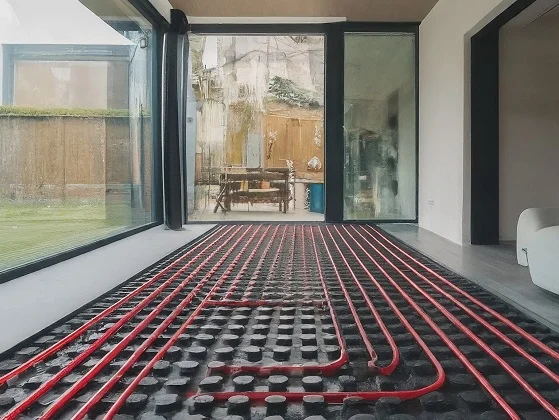
You may hear electric underfloor heating referred to as dry underfloor heating. This type of underfloor heating works by producing radiant heat through electric heating wires or heating mats installed under the floor. These are connected via the mains electricity supply and when turned on, will warm the surface of the floor. This results in generating and releasing radiant heat. Electric underfloor heating systems are controlled via thermostats.
- Best For Projects:
Electric underfloor heating is a good idea when you’re renovating rooms and retrofitting. This underfloor heating system is also one that’s becoming increasingly popular in new build projects thanks to the drive to cut carbon emissions in new builds and the ongoing aim to achieve net zero. Electric underfloor heating is also an ideal option for small single rooms, such as ensuites and family bathrooms.
- Installation Process
Electric underfloor heating is considered the easier of underfloor systems to install. This is in part thanks to its rapid installation time, meaning it can take anything from a few hours to a day to complete the entire process. Alongside this benefit, the impact on floor height is minimal here with an electric underfloor heating system. So, you can further reduce any need for too much disruption or indeed extensive DIY knowledge.
What Should I Know About Water Underfloor Heating?
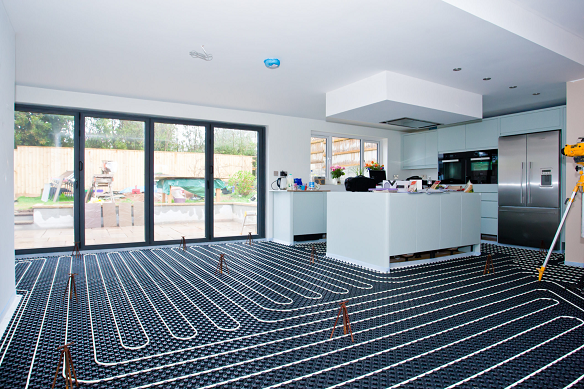
Water underfloor heating is also known as wet underfloor heating or hydronic. This type is also referred to by many as a Roman heating system with modern-day pipes. Water underfloor heating works using a network of pipes all installed beneath the floor. These pipes work to pump warm water through the pipework via a manifold and to all the rooms serviced by the underfloor heating system. With separate circuits used for different zones and connected to the central manifold, the manifold is then fed by the property’s primary heat source. Air source or ground source heat pumps are also good options for use as a heat source when increasing the system's efficiency further.
- Best For Projects:
Water underfloor heating is a better choice for new builds and larger spaces, as you can install this system in almost any room if the right infrastructures are in place. Water systems are ideally best suited to new builds because they require a sufficient floor height to accommodate the extensive pipework of such a heating system. For homeowners renovating, water underfloor heating systems will demand major disruption. Yet, there are those systems available on the market for retrofit projects which create minimal uplift to floor heights.
- Installation Process:
As water underfloor heating is a complex process, it’s understandable that it requires a longer installation time. This is mainly because of the room size and/or the project type it's used in, as well as the plumbing connections and tests required. Therefore, a water underfloor heating system installation can take longer to complete. Another delay here though is that although competent and confident DIYers may attempt this process, it's highly recommended to use a registered plumber when installing this system as they’ll ensure all pipes and connections are completed correctly.

Is Underfloor Heating Expensive to Run?
Generally, underfloor heating (UFH) is not necessarily expensive to run in the UK; however, the cost varies significantly depending on the system type. Wet (hydronic) UFH is substantially cheaper to run than electric UFH, especially for whole-house heating.
The choice is a trade-off: electric systems are cheaper to install but more expensive to run, while wet systems are the reverse.
Wet vs. Electric UFH: Cost Breakdown (UK)
The comparison below highlights the typical differences in installation and running costs. Costs are estimates based on various UK sources and prevailing energy prices. Gas is approximately 6.29 p/kWh, and Electricity is approximately 26.35 p/kWh (as of late 2025 estimates).
Comparison between Wet (Hydronic) and Electric Underfloor Heating (UFH)
Wet (Hydronic) UFH (Connected to a boiler/heat pump)
- Initial Installation Cost (Supply & Fit): Higher.
Renovation: Typically £100 - £190 per m2
New Build: Typically £100 - £140 per m2
- Running Cost: Lower.
Annual costs for a medium room (15m2) are roughly £200 - £300 (depending on usage and insulation).
- Best Suited For: Whole homes, large areas, or frequent, long-term use (where the lower running cost offsets the installation price).
- Heat Up Time: Slower (due to screed/mass heating) but retains heat well.
Electric UFH (Connected to mains electricity)
- Initial Installation Cost (Supply & Fit): Lower.
Renovation: Typically £50 - £90 per m2
New Build: Typically £40 - £80 per m2
- Running Cost: Higher.
Annual costs for a medium room (15 m2) are roughly £1,000 - £1,300 (depending on usage and insulation).
- Best Suited For: Small, single rooms (e.g., bathrooms, en-suites) or retrofits where minimal floor height increase is essential.
- Heat-up Time: Faster (especially with thin mat systems).
Conclusion:
- For a single, small room (like a bathroom) or a simple retrofit, Electric UFH often makes sense due to low installation cost.
- For heating a whole house or any frequently used area over 20 m2, Wet UFH delivers significantly lower long-term running costs and is the best value over the system's lifetime.
Electric Underfloor Heating Running Costs
You can estimate your running cost for underfloor heating using a basic energy formula. This is much easier for electric UFH as the power consumption is fixed per square metre (e.g. 150W/m2).
1. Electric UFH Cost Calculation
The cost is based on the system's wattage, usage time, and your electricity price.
Annual Running Cost = (Area (m2) x Wattage (kW/m2) x Hours Used x Days Used) x Electricity Price (£/kWh)
Example Calculation (Electric):
Electric UFH Cost Calculation Example
This calculation estimates the annual running cost for a 10 m2 room using a standard 150 W/m2 electric underfloor heating system.
- Room Area: 10m2 (e.g. a small kitchen/lounge).
- System Wattage: 0.15 kW/m2 (standard 150W/m2 system).
- Daily Use: 6 hours (e.g.Morning 2h & Evening 4h).
- Days Used per Year: 182 days (approximately 6 months of heating during the UK winter).
- Electricity Price: £0.2635 kWh (based on an estimated UK price cap for Late 2025).
Note: This calculation assumes the system runs at full power for the entire duration, which is rarely the case thanks to thermostats and good insulation. Actual costs are typically lower.
2. Wet UFH Cost Calculation
Calculating the cost for wet UFH is much more complex because it depends on the efficiency of your boiler/heat pump and the required flow temperature, rather than a fixed electrical wattage.
Annual Running Cost = Heat Output Required (kWh) / Boiler Efficiency x Gas Price (£/kWh)
- Heat Output Required: This is a professional design calculation based on the room's heat loss, insulation, and target temperature.
- Boiler Efficiency: A modern condensing boiler is 90-95% efficient. A heat pump is 300-400% efficient (known as its CoP).
Wet UFH is typically 3 to 4 times cheaper to run than electric UFH because gas is cheaper per kWh than electricity, and the system runs efficiently at low temperatures (40-45C).
Running Cost Factors to Consider When Choosing Underfloor Heating
The true running cost is heavily influenced by four main factors:
- Insulation Quality (The biggest factor): Crucial and often overlooked. Effective thermal floor insulation underneath the UFH system prevents heat from escaping downwards, forcing it up into the room. Poor insulation can double running costs. Good wall, window, and roof insulation also reduces the total heat needed.
- Room Size & Usage: Electric UFH costs rise sharply with room size. Wet UFH is the better choice for large, open-plan areas and rooms used all day.
- Floor Covering: Tiles and stone are excellent thermal conductors, allowing the UFH to run at lower temperatures and less often. Thick carpets or rugs can significantly impede heat transfer, making the system work much harder and increasing costs.
- Energy Source & Tariff: The cost difference between electricity (approx 26 p/kWh) and gas (approx 6 p/kWh) is the primary reason for the large running cost disparity between electric and wet systems.
Suggestions to Reduce Underfloor Heating Running Costs Long-Term
Once your system is installed, you can optimise its performance to save money. Here are some suggestions to help you reduce your energy consumption.
For Both Wet (Hydronic) & Electric Systems
- Use Programmable/Smart Thermostats: Program the system to only heat when and where you need it. Use the "optimum start" feature to calculate the ideal time to turn on, ensuring the floor is warm exactly when needed.
- Maintain Low & Consistent Temperatures: UFH works best by maintaining a lower, constant background temperature (18-20°C) rather than turning it off completely and reheating from cold, which requires more energy.
- Don't Block the Floor: Avoid placing thick rugs or large, flat-bottomed furniture directly on the heated floor area, as this traps heat and reduces the efficiency of the heating system.
Wet UFH Specific Strategies
- Reduce Flow Temperature: Set your boiler/heat pump to the lowest possible flow temperature that still achieves your desired room temperature. This significantly improves the efficiency of condensing boilers and heat pumps.
- Pair with a Heat Pump: Running wet UFH with an Air Source or Ground Source Heat Pump can be up to 40% more efficient than with a gas boiler due to the pump's superior compatibility with low flow temperatures.
Electric UFH Specific Strategies
- Utilise Off-Peak Electricity: If you're on an Economy 7 or similar tariff, program the UFH to run during the cheaper, off-peak hours, allowing the floor (especially screeded floors) to store heat.
- Ensure Excellent Under-Floor Insulation: If you're retrofitting, ensure you use the thinnest, highest-rated insulation boards available to maximise upward heat projection and minimise downward heat loss.
If you're looking for further help on choosing the best underfloor heating system, contact our Renewables Team at City Plumbing. Experts in the latest energy-efficient technologies, we're perfectly placed to help homes and businesses make the smooth transition to renewable technology.