



Favourites

Account

Basket
VAT:
Ex
Inc


There's been significant growth in solar for urban living as more people living in flats and apartments seek sustainable energy solutions and look to capitalise on the financial and environmental benefits of renewable power.
However, for many, there’s a major challenge to this burgeoning trend: a lack of roof ownership or access, which complicates the process, especially in typical UK solar panel hotspots.
City Plumbing is here to explain that even though obtaining permission and navigating shared ownership can be a hurdle, for many it is possible to install solar on flats. With our complete guide, we’ll walk you through the practical steps, innovative solutions, and legal considerations to make it happen.
Who Can Install Solar Panels on a Flat?
The core difficulty in installing solar on a flat in the UK is access to and ownership of the roof, followed by obtaining consent from the freeholder/landlord and, potentially, planning permission from the local council (as flats are often an exception to "Permitted Development" rights).
Here is a breakdown of who can install solar panels on a flat in the UK, based on the type of ownership and the initial permission required:
The ability to install solar panels hinges entirely on two things: who legally owns the external fabric of the building (the roof) and the specific terms of the lease/tenancy agreement:
Solar Installation Permission by Resident/Owner Type (UK Flats)
- Flat with Sole Access to a Roof
Roof Status: The top-floor owner often has exclusive access to the roof (e.g., a terrace), but the freeholder or management company typically owns the roof structure itself.
Initial Permission: Possible, but not certain. You will almost certainly need to obtain freeholder consent (a Licence to Alter) and may still require planning permission from the Local Authority.
- Shared Roof on an Apartment Block
Roof Status: The roof is a communal area owned by the freeholder or a management company.
Initial Permission: Possible, but complex. Requires agreement from the freeholder/management company and usually involves installing a shared solar system to benefit multiple flats or communal areas. A full block agreement may be needed.
- Tenants (Renters)
Roof Status: Tenants do not own the property or the roof structure.
Initial Permission: Needs Landlord/Freeholder Approval. The tenant must obtain explicit, written permission from the landlord (who may also need freeholder consent), as the installation affects the building's structure.
- Leasehold Owners
Roof Status: The flat owner owns the interior, but the freeholder owns the external structure (including the roof).
Initial Permission: Normally Not Possible Due to Lease Restrictions. The lease usually prohibits alterations to the exterior. You must formally apply to the freeholder for consent, which may be granted subject to specific conditions (e.g., structural surveys, payment of legal fees).
Important Note on Planning Permission
For all flat installations, you must also consider planning permission. Unlike typical houses, which benefit from 'Permitted Development' rights for solar, the installation of solar on a block of flats or an apartment building often requires a formal Planning Application to the Local Authority.
Always check with your local planning office or a certified solar installer.
What Are the Best Solar Panels for Flats?
Flats immediately introduce constraints that determine the best product choice: limited space, weight restrictions, and often the need for non-invasive installation.
Unlike detached houses, the best solar panels for a flat are usually those that maximise efficiency while minimising structural impact.
For flat owners, the solar market offers distinct solutions, depending on whether you have access to the main roof or only a private balcony.
1. High-Efficiency, Lightweight Panels (For Shared/Flat Roof Access)
When permission is secured for the main roof, the goal is to get the most power from the limited space. Traditional solar panels can be heavy, requiring costly structural checks.
The best panels for flats address the common challenges of limited space and structural constraints.
- High-Efficiency Modules (23%+)
Why It Matters: These panels maximise energy output from the fewest possible panels, which is crucial when roof space is limited.
Product Examples (UK Market): SunPower Maxeon, AIKO NEOSTAR, LONGi Hi-MO Series. (These brands frequently achieve top efficiency rankings.)
- Lightweight/Flexible Modules
Why It Matters: Using lighter panels reduces the roof load and helps avoid the need for expensive structural reinforcement, making the proposal more appealing to freeholders.
Product Examples (UK Market): Heliup Stykon (Adhesive, often 60% lighter than conventional panels), CIGS Flexible Panels (Peel-and-stick, wafer-thin designs).
Why It Matters: These are essential, especially for shared roofs in urban areas. They ensure that shading on one panel (e.g., from a nearby chimney or building) does not reduce the output of the entire solar system.
Product Examples (UK Market): Enphase Microinverters or systems utilising SolarEdge Optimisers.
- Shared System Solution
Why It Matters: This is a dedicated system for multi-unit buildings, designed to efficiently distribute energy generated by a single rooftop array to individual flats or common areas.
Product Examples (UK Market): Allume Energy SolShare (a leading UK-specific solution for apartment block solar sharing).
------------------------------------------------------------
2. Plug-and-Play Balcony Systems (For Tenants/Leaseholders)
These are arguably the most accessible solution for flat dwellers as they require minimal structural alteration, often making landlord/freeholder permission easier to obtain (though still recommended)
These solutions are the most accessible for flat residents, particularly those who lack roof access or face strict lease covenants.
- Balcony-Mounted Kits
Key Feature: These are small systems (typically 1–4 panels) that are frame-mounted onto balcony railings and plug directly into a wall socket via a micro-inverter. They are designed for easy, often non-invasive installation.
Output & Cost (Approx.): Typically generates 300–800W. The cost generally ranges from £300 to £1,500.
Suitability:
Perfect for Renters, Tenants, or Leaseholders facing strict covenants.
Ideal for offsetting the base load electricity usage (e.g., powering appliances that run constantly like fridges, freezers, and routers).
- Plug-In Solar Kits
Key Feature: These kits are designed to be non-permanent and highly portable, allowing the user to take them with them if they move house.
Estimated Savings: A typical 400W panel can save £150–£250 annually on electricity bills.
Suitability:
Ideal for apartments with south, east, or west-facing balconies that receive consistent, direct sunlight throughout the day.
Solar Panels on Flats: Planning Permission Considerations
Planning laws dictate what is technically feasible once freeholder consent is obtained. For solar panels on residential buildings, the UK government has granted Permitted Development (PD) Rights to encourage green energy, but these rights are limited for flats and special designation areas.
Legislation Breakdown: Permitted Development Rights:
The legislation governing solar panel installation is primarily found in The Town and Country Planning (General Permitted Development) (England) Order 2015 (Part 14, Class A), and similar regulations apply in Wales, Scotland, and Northern Ireland.
These rights essentially give individuals automatic permission to install solar panels without making a formal planning application, provided certain limits and conditions are met.
General Rule: Permission Usually Not Needed
For most houses, and indeed for many parts of apartment blocks, planning permission is not required for solar panel installation, provided the following PD conditions are met:
- Projection: The panels must not protrude more than 200mm (0.2 metres) from the roof slope or wall surface.
- Height: The panels must not be installed above the highest part of the roof (excluding chimneys).
- Visual Impact: The equipment must be sited, as far as practicable, to minimise the effect on the external appearance of the building and the amenity of the area.
Crucially, recent changes (November 2023) specifically addressed flat roofs, allowing panels to protrude up to 0.6 metres (60cm) above the highest part of the flat roof without planning permission.
Key Exceptions: When Planning Permission IS Required
Even if your installation meets all the size and height requirements, PD rights are often restricted or entirely removed in the following scenarios, making a formal application necessary. A formal application is necessary in these scenarios:
- Listed Buildings
Planning Requirement: Always requires Listed Building Consent and usually formal planning permission.
Key Restriction: Installation is judged on a case-by-case basis. The presumption is against external panels unless they can be completely hidden from view to protect the building's historical integrity.
- Conservation Areas
Planning Requirement: Requires planning permission if panels are to be fitted on a wall or principal elevation that fronts a highway (road, path, or public right of way).
Key Restriction: Some Conservation Areas have Article 4 Directions, which remove all PD rights for solar panels, requiring a full application.
- Properties Affected by an Article 4 Direction
Planning Requirement: Formal Planning Permission is Mandatory.
Key Restriction: These directions are issued by the Local Authority specifically to protect the character of an area by removing typical PD rights.
- Flat Roof Installations (in Conservation Areas)
Planning Requirement: Requires Prior Approval from the Local Authority to assess the visual impact on the area's appearance, even if the new 0.6m height limit is met.
Key Restriction: If the Authority deems the visual impact detrimental, full planning permission may be required.
- Exceeding PD Limits
Planning Requirement: Formal Planning Permission is Required.
Key Restriction: This applies if the panels:
- Project more than 200mm from a pitched roof.
- Project more than 0.6m from a flat roof.
- They are installed higher than the roof ridge.
Seeking Help and Guidance
Because the rules for flats (blocks of flats vs. single dwellings) and conservation areas can vary significantly between local authorities, it is always recommended to seek professional guidance:
- Freeholder/Management Company: They hold information on any specific planning conditions or covenants that affect the property. This information is separate from national PD rights but just as binding.
- Local Authority: Contact your Local Planning Authority (LPA) directly. You can request either:
Pre-Application Advice: A formal consultation with a planning officer.
A Lawful Development Certificate (LDC): An application that, if approved, provides legal proof that your proposed installation does not require planning permission.
The Benefits of Solar Panels for Flats
1. Cost & System Size
- Upfront Cost for Panels: Due to the smaller area and required system size (typically 1kW–3kW) compared to a house (3.5kW–4kW), the cost of the panels and inverters is generally lower.
Example: A suitable 1kW system for a flat can cost around £3,800 – £4,600 installed (excluding specialist access costs).
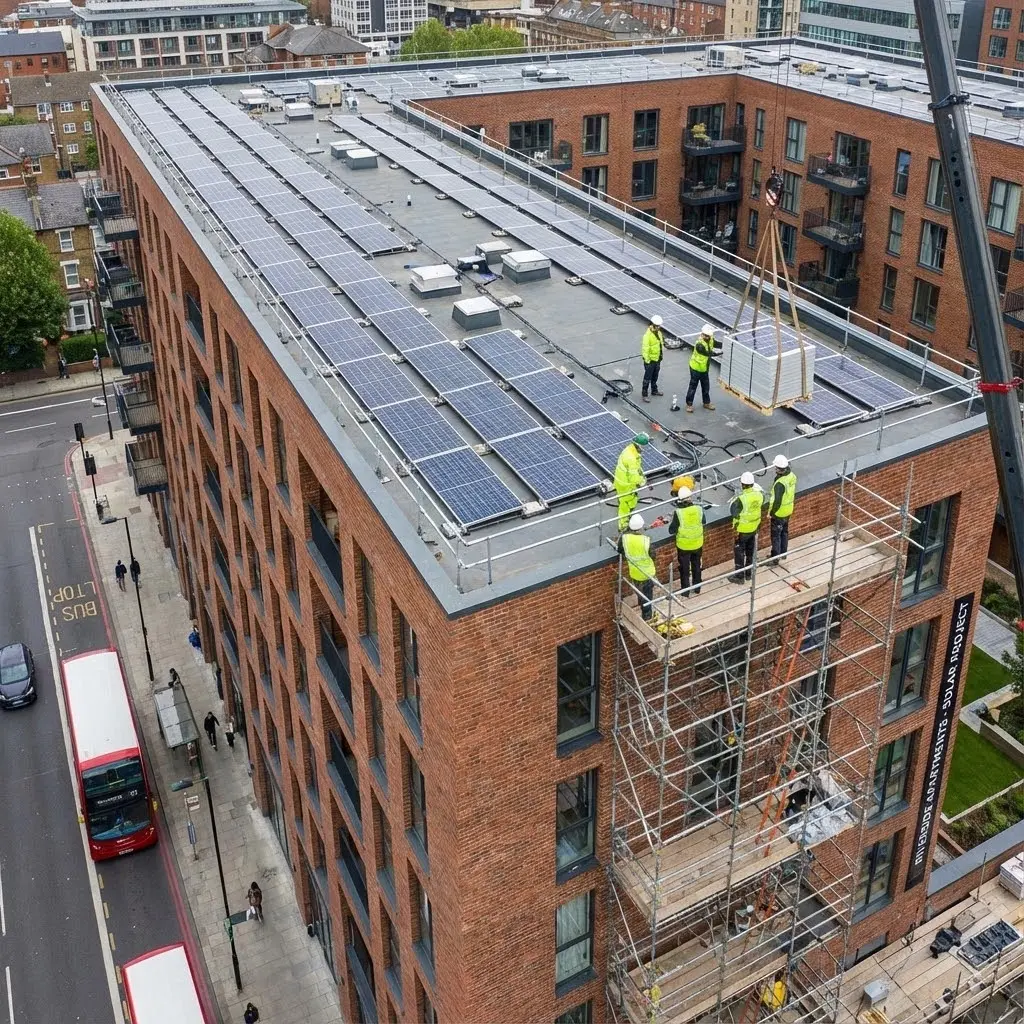
- Initial Installation Costs (The Hurdle): Installation costs may be higher initially due to access constraints. The cost of scaffolding or specialist lifting equipment for tall apartment blocks can significantly inflate the total project cost.
Mitigation: These high access costs can be split if multiple flats or the entire building management agrees to install solar at the same time, making the project viable for individual units.
- VAT Benefit: Solar panel installation benefits from 0% VAT (until March 2027), which applies equally to flats and houses.

2. How Much Power Can Be Generated
The systems are highly effective because the generated power often closely matches the flat's electricity needs, maximising self-consumption.
- Balcony / Small Array (0.4 kWp – 1 kWp):
Estimated Output: 400 kWh – 900 kWh annually.
Typical Use: Offsets the base load (fridges, routers, etc.), potentially halving a small household's electricity bill.
- Shared Roof Allocation (1 kWp – 2 kWp):
Estimated Output: 900 kWh – 1,800 kWh annually.
Typical Use: Can cover 70-100% of a typical 1–2 bedroom flat's annual electricity usage (average consumption is around 1,500 kWh).
- Communal System (5 kWp +):
Typical Use: Powers common areas (hall lights, lifts), reducing the building's overall service charges for all residents.
--------------------------------------------------------------
3. Financial Benefits Beyond Savings
- Smart Export Guarantee (SEG): You can get paid for any excess electricity generated that you do not use and export back to the National Grid.
- Increased Property Value: Solar panels are a desirable upgrade that can significantly increase your flat's value and improve its Energy Performance Certificate (EPC) rating.
- Reduced Service Charges: For communal systems, reductions in the building's shared electricity bills directly translate into lower service charges for all leaseholders.
Why Solar on UK Flats Makes Financial Sense
The journey to installing solar panels on a flat may involve more steps than a standard house installation, but the answer to the central question is a resounding yes: Solar panels are possible for flats, even though there may be initial challenges in installing them.
By understanding the difference between technical feasibility alongside the legal hurdles (such as securing freeholder or landlord consent), you can approach the process strategically.
The financial benefits, particularly the ability to secure a low base-load supply of free electricity and protect the property’s value, make the effort of creating greener homes highly worthwhile.
Speak to a City Plumbing expert about our extensive range of Solar Panels for your next project. Visit our website for more products and advice to keep your customers happy this season.
Help & Feedback
 Chat With Us
 Give Us Feedback