


Favourites

Account

Basket
VAT:
Ex
Inc


 45 years of trusted expertise
The UK heating sector is undergoing a structural shift, and the air to air heat pump UK market is moving rapidly from a commercial air-conditioning niche into a grant-supported, mainstream residential heating technology. For installers mapping out their business pipeline, understanding the exact status of this transition is highly necessary.
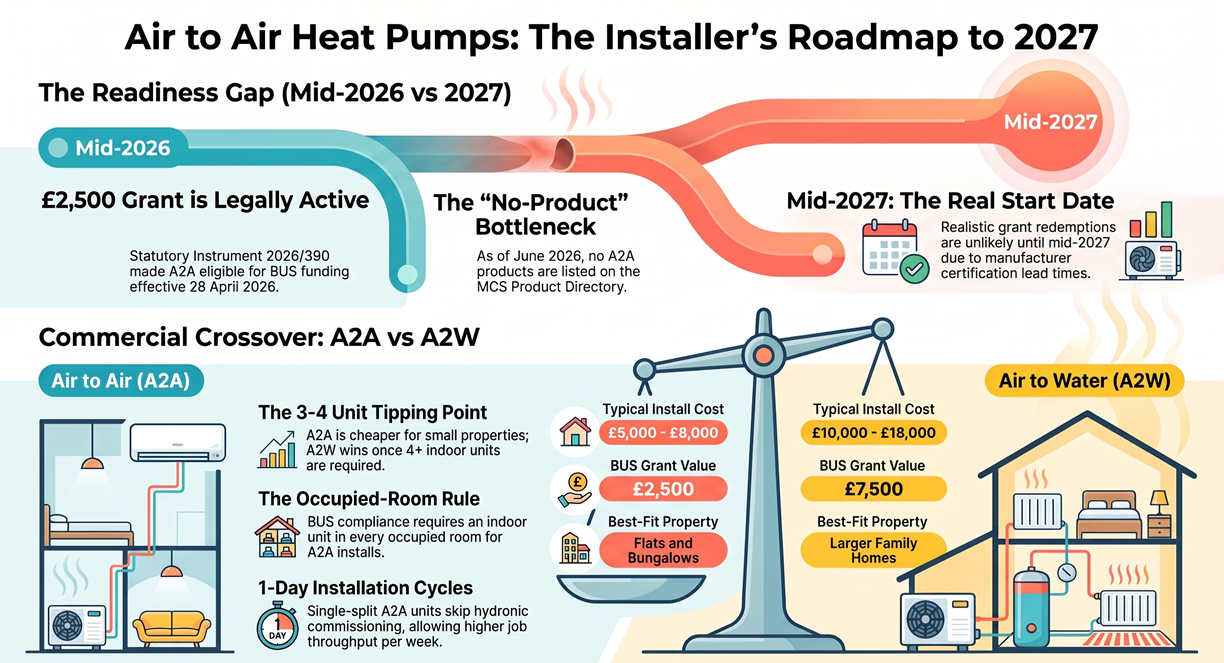
As of mid-2026, the regulatory framework and subsidy rules are in place. The Boiler Upgrade Scheme (BUS) criteria have been expanded to include this technology, and the overarching installation standards have been drafted to accommodate it. However, because there are no publicly listed MCS-certified A2A products as of June 2026, the market is sitting in a waiting period. The hardware required to complete a fully compliant, grant-funded installation is not yet available on the directory. Consequently, realistic BUS redemptions will likely lag into mid-2027.
This delay creates a distinct operational window. The trade professionals who understand the specific commercial applications of an air to air heat pump, grasp the certification requirements, and close their own skills gaps now will be the contractors securing the early profitable work when the product supply chain catches up with the legislation.
What is an Air to Air Heat Pump and How Does it Work for Heating?
When assessing how an air heat pump works in this context, the primary distinction is the removal of the wet system. An A2A setup does not heat water; it does not use a cylinder, and it does not connect to a radiator circuit. Instead, it uses a refrigerant circuit to extract heat from the outside ambient air and transfers that thermal energy directly into the property using indoor fan coil units.
For the heating season, the airflow dynamics are highly specific. Installers must position high-wall units so they wash warm air across the ceiling. This allows the warm air to circulate down naturally into the living space, creating an even temperature distribution while preventing direct drafts on the occupants. This is a very different comfort profile compared to the radiant heat of a traditional wet system, and managing customer expectations around air movement is a core part of the sales process for any heating and aircon unit.
From a performance standpoint, modern units are engineered for northern European climates. Cold weather performance operates down to -15C to -20C, with a SCOP of roughly 3.5 to 4.5 in GB conditions. This efficiency profile makes the heat pump and air conditioner hybrid a highly viable primary heating source, provided the heat load calculations of the property are accurate and the building fabric is adequately insulated.

The Boiler Upgrade Scheme (BUS): Where the Rules Actually Stand (Mid-2026)
The primary driver for the current interest in A2A is the availability of government subsidies. Understanding the exact parameters of the air to air heat pump grant is central to producing accurate quotes for homeowners considering a home heat pump.
As of mid-2026, the Boiler Upgrade Scheme (BUS) pays a £2,500 grant for A2A, compared to £7,500 for Air to Water (A2W). To access this grant, the installation must be signed off under the Microgeneration Certification Scheme (MCS), which remains the sole certification route for BUS eligibility.
The grant rules dictate strict design parameters. Crucially, the BUS rules dictate an indoor unit is required in every occupied room. You cannot install a single high-capacity unit in a hallway and claim the grant based on natural heat migration throughout the house. Every living room, bedroom, and study must have a dedicated heat emitter.
The present operational barrier is product certification. The standards allow A2A, but as stated, there are no publicly listed MCS-certified A2A products as of June 2026. Until manufacturers push their specific models through the MCS product certification process and get them listed on the public directory, you cannot generate a compliant BUS voucher. Installers should use this period to adapt their quoting software, understand the occupied room rule, and wait for the official product listings before promising grant-funded installation dates to clients.
A2A vs Air to Water (A2W) Heat Pumps: Where the Money Works
Deciding whether to pitch A2A or A2W comes down to simple commercial mathematics and property typologies. The air to air heat pump cost uk dynamics are completely different from wet system retrofits, and understanding the crossover point is how installers protect their margins.
The installed cost ranges demonstrate this divide. A2A is roughly £5,000-£8,000 to install; A2W is roughly £10,000-£18,000. When calculating the air source heat pump costs UK for an A2A system, the pricing scales linearly with the number of rooms. Per indoor unit, A2A works out around £1,500-£2,300 fitted.
Because of this per-unit scaling, there is a hard crossover point: A2A wins commercially for properties needing under 3-4 indoor units (e.g., 2-bed flats, bungalows, small open-plan homes). Above 3-4 units, A2W is cheaper. Once a property requires five or six indoor fan coil units, the hardware costs, the complex refrigerant pipework runs, and the labour required make an A2W wet system a far more logical and cost-effective specification.
For the properties that do fit the A2A profile, the installation timeframes are highly attractive. By avoiding hot water cylinders, buffer tanks, and the disruption of lifting floorboards to upgrade radiator pipework, a single-split or straightforward multi-split system can often be completed in a single working day.
System Type - Air to Air (A2A)
- Typical Installed Cost: £5,000 - £8,000
- BUS Grant Available: £2,500
- Typical Install Time: 1 - 2 Days
- Best-Fit Property: Under 3-4 rooms (Flats, small bungalows)
System Type - Air to Water (A2W)
- Typical Installed Cost: £10,000 - £18,000
- BUS Grant Available: £7,500
- Typical Install Time: 4 - 7 Days
- Best-Fit Property: 4+ rooms (Standard semi-detached/detached)
When designing an A2A system to meet the BUS requirements, installers must account for non-occupied rooms such as hallways, landings, and bathrooms. Installing refrigerant-based fan coil units in these small transitional spaces is rarely cost-effective or physically practical. To remain compliant while maintaining a clean design, installers should specify efficient electric heating for these areas. Integrating standard electric panel heaters for circulation spaces or electric plinth heaters where wall space is restricted provides a highly effective, compliant solution without over-engineering the heat pump design.
The F-Gas and MCS Skills Gap: Getting Ready for 2027
The transition to A2A installations requires a specific blend of competencies that very few contractors currently hold in full. Any air to air heat pump installer looking to capitalise on the incoming BUS work must hold both F-gas certification and the relevant MCS accreditation.
Currently, the workforce is split into two distinct trades, each with a specific skills gap to close:
- Air Conditioning Contractors: These professionals hold the mandatory F-gas handling certificates required to work with pre-charged split systems and route refrigerant pipework. However, they typically operate entirely outside the domestic grant sector and lack the required MCS certification for heat pump installations.
- Heating and Plumbing Contractors: These installers are highly experienced in domestic heating loads, homeowner handovers, and the administrative requirements of the MCS framework. However, because they traditionally work with monobloc A2W units (where the refrigerant circuit is sealed at the factory), many lack the F-gas category qualifications required to install split A2A systems.
To be ready for the expected product rollout in 2027, you must identify which side of this divide your business sits on. If you are an AC engineer, you need to begin the MCS onboarding process. If you are a wet-heating engineer, you need to book your engineers onto an F-gas training course.
Frequently Asked Questions (FAQs)
Do air-to-air heat pumps use radiators?
No. An air-to-air system completely bypasses the traditional wet circuit. Instead of heating water to pump through steel radiators or underfloor heating manifolds, they extract heat from the outside air and deliver it straight into the room via wall-mounted or floor-mounted fan coil units. For customers asking if heat pumps use radiators, you must explain that A2A requires a totally different heat delivery method.
Can air source heat pumps cool your home in the summer?
Yes. One of the primary advantages of an A2A system is its dual-purpose nature. By reversing the refrigerant cycle, the units extract heat from inside the property and reject it outside, providing highly effective air conditioning during the summer months. For clients wanting both heating and cooling from a single capital investment, A2A is the only viable technology. When discussing whether air source heat pumps can cool, always clarify that this applies to A2A systems, as A2W systems paired with standard radiators cannot provide space cooling.
Is an air-to-air heat pump suitable for a flat?
Yes. Due to the exact commercial crossover point mentioned earlier, a heat pump for flat installations is where A2A excels. Because a standard flat typically only requires two to three indoor units, the total hardware count remains low, making it far cheaper than retrofitting a wet system. Furthermore, flats often lack the physical space for the hot water cylinders required by A2W systems, making A2A the most practical heat pump in flats solution.
What happens to hallways and bathrooms under the BUS rules?
Under the strict grant criteria, the heat pump must provide the primary space heating, but installing an indoor air unit in every tiny transitional space is impractical. Therefore, non-occupied rooms require efficient electric heating to stay compliant and ensure the property meets its overall heat loss requirements. Using an air conditioner heater combo for the main living spaces and supplementing with electric panel heaters or towel rails in the bathrooms is the standard, compliant design route.